
Nonionic PAM flocculant has very low ionic content and relies mainly on adsorption and bridging. It can be useful in selected acidic, low-charge or mixed-mineral systems, but it occupies a narrower starting position than the anionic and cationic families.
Where nonionic PAM may enter a screen
Potential duties include selected mineral processing streams, acidic water, coal or clay suspensions and systems where strong anionic or cationic interaction gives a narrow operating window. Nonionic products are also compared when process chemistry changes the apparent surface charge. The application label alone is not sufficient evidence.
Use a comparative test, not a single-product test
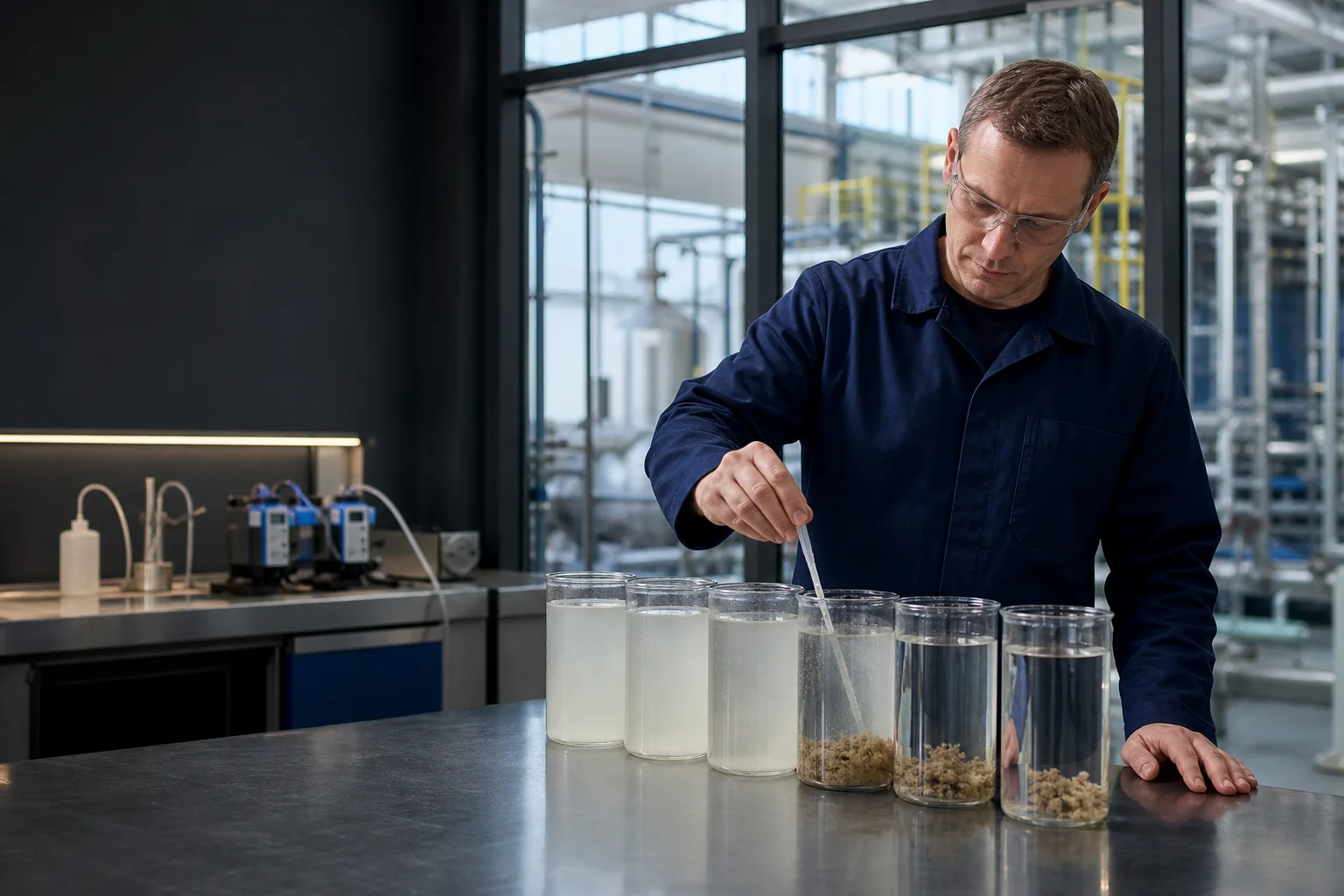
Screen nonionic PAM beside low-charge anionic candidates under identical preparation and mixing conditions. Include a blank. Measure more than settling speed: compare supernatant quality, floc strength, compaction, filtration behavior and sensitivity to overdose. If water chemistry varies, repeat the comparison at the conductivity and pH limits expected in production.
Preparation and distribution
Low-charge products can still have high molecular weight and high solution viscosity. Uniform wetting and complete hydration are essential. After aging, avoid centrifugal pumps or throttling points that can damage long chains. Dilute the activated stock enough to distribute it across the full process stream without creating a concentrated contact zone.
Questions to answer before ordering
- What are the pH, conductivity and temperature ranges?
- What solids or precipitates must be separated?
- Is an inorganic coagulant added first?
- Does the process settle, float, filter or dewater the floc?
- Which result currently limits throughput or water quality?
The answers allow a supplier to decide whether nonionic PAM belongs in the first sample set or whether a low-charge ionic grade is the stronger starting point.