
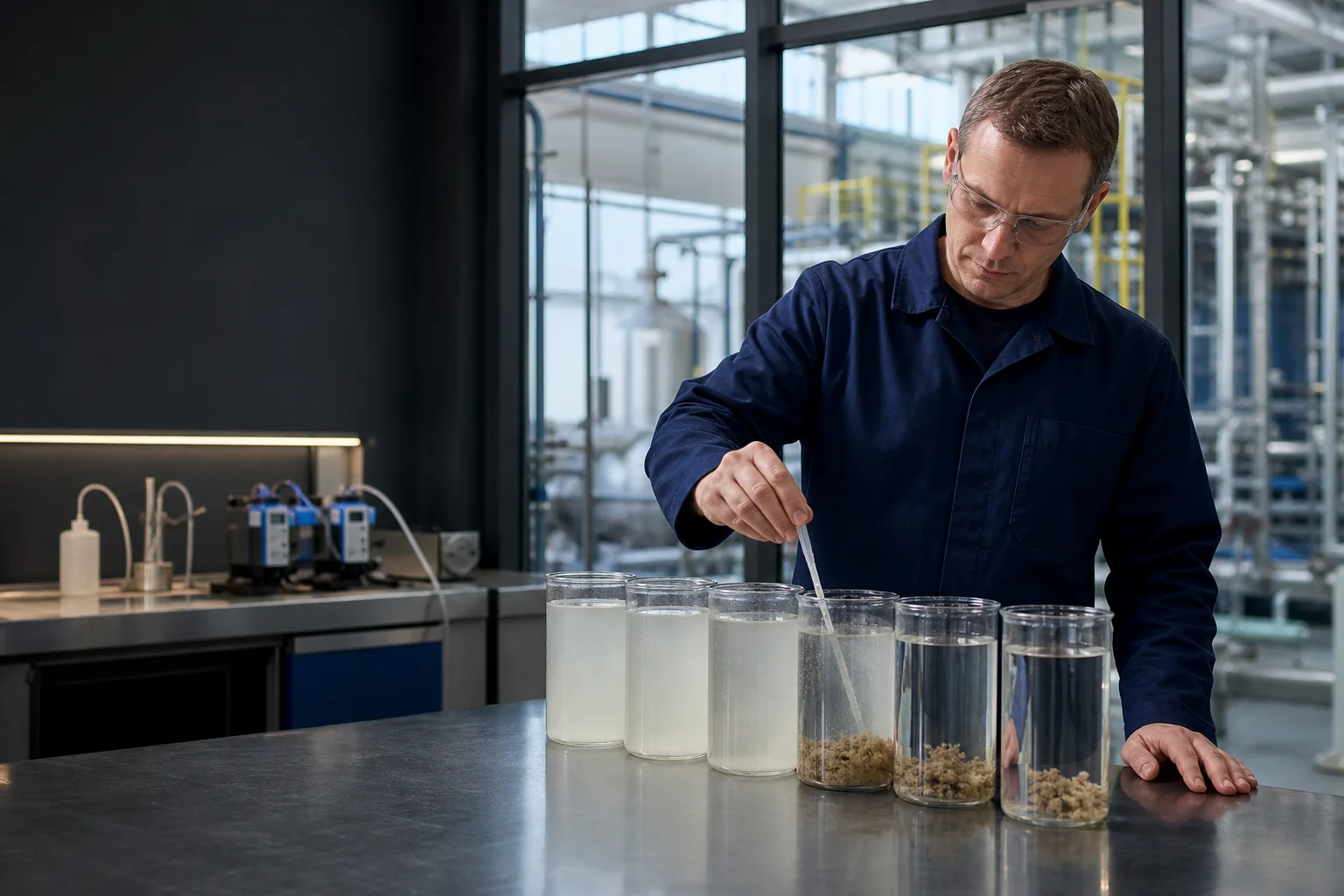
A useful PAM flocculant trial begins before the samples arrive. Define the feed, equipment and decision criteria so each test answers a commercial or operating question.
Describe the feed
Industry and process, solids type, TSS or dry solids, pH, conductivity, temperature, oil or surfactants, current coagulants and normal variability.
Define the target
Overflow turbidity, settling rate, underflow density, DAF float quality, capture, cake solids, throughput, filtration time or another measurable result.
Control preparation
Use identical active concentration, make-down water, wetting method, aging time and transfer conditions for every candidate.
Build a dose curve
Include a blank, underdose, expected range and an overdose point. Change one factor at a time and record active dose.
Confirm on equipment
Carry only the strongest candidates into a plant trial and measure the machine-specific endpoints over representative feed cycles.
Minimum RFQ information
| Category | Useful details |
|---|---|
| Material | Water, sludge or slurry source; dominant solids; sample age |
| Chemistry | pH, conductivity, temperature, coagulant and other additives |
| Equipment | Clarifier, thickener, DAF, centrifuge, belt, screw or filter press |
| Current result | Product type, active dose, clarity, capture, cake or throughput |
| Supply | Monthly quantity, packaging, destination port or city, required documents |
What to photograph and record
Photograph the untreated feed, floc at the same elapsed time, supernatant or filtrate, and final solids. Record stock concentration, exact addition volume, mixing sequence and settling time. For a plant trial, capture flow, solids, pump setting and equipment conditions. Photos without dose and timing are difficult to compare.
Use the result to narrow the next decision
If all products fail, review coagulation, pH, sample condition and preparation before requesting more grades. If several work, compare operating window and total treatment cost. If one works only at a narrow dose, test an adjacent charge or molecular-weight range. Send the complete record to the supplier so the next recommendation is evidence-based.