
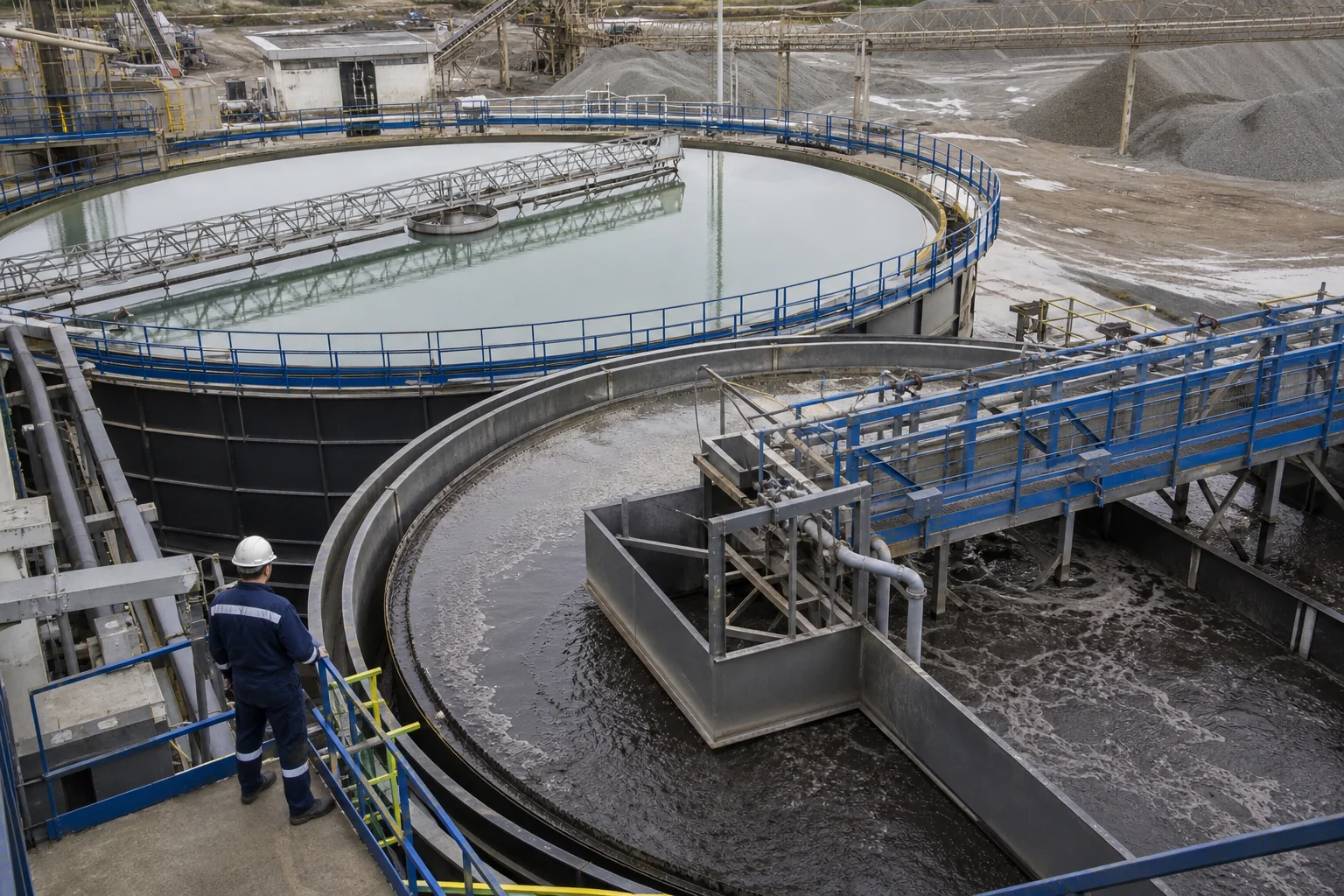
A PAM flocculant does not perform in isolation. Mixing energy, contact time, addition sequence and the separation equipment decide whether a promising laboratory floc becomes a stable plant result.
Define the controlling result
For a clarifier, the controlling result may be turbidity or hydraulic throughput. For a thickener, it may be underflow density or rake torque. A DAF unit may be constrained by float blanket stability, oil removal or skimmer loading. A dewatering machine may be limited by cake solids, capture, throughput or filtrate quality. The trial must measure the plant constraint, not merely floc size.
Preserve the chemistry through the hydraulic path
Polymer needs enough initial dispersion to contact particles, followed by lower shear that allows bridges to form. Pumps, valves, pipe elbows and poorly designed inlets can destroy formed floc. If a jar test succeeds but the plant fails, inspect stock concentration, injection location, downstream shear and residence time before changing grade.
Use scale-up evidence
Bench screening narrows the candidate list. Pilot or plant trials confirm the equipment response across real feed variation. Hold other chemicals and operating settings as stable as practical, then change one variable at a time. Record active dose and throughput so results can be compared after the trial.
The U.S. EPA field manual emphasizes gentle flocculation, site-representative jar testing, polymer-feed concentration and mixing intensity. Review the EPA field manual.