
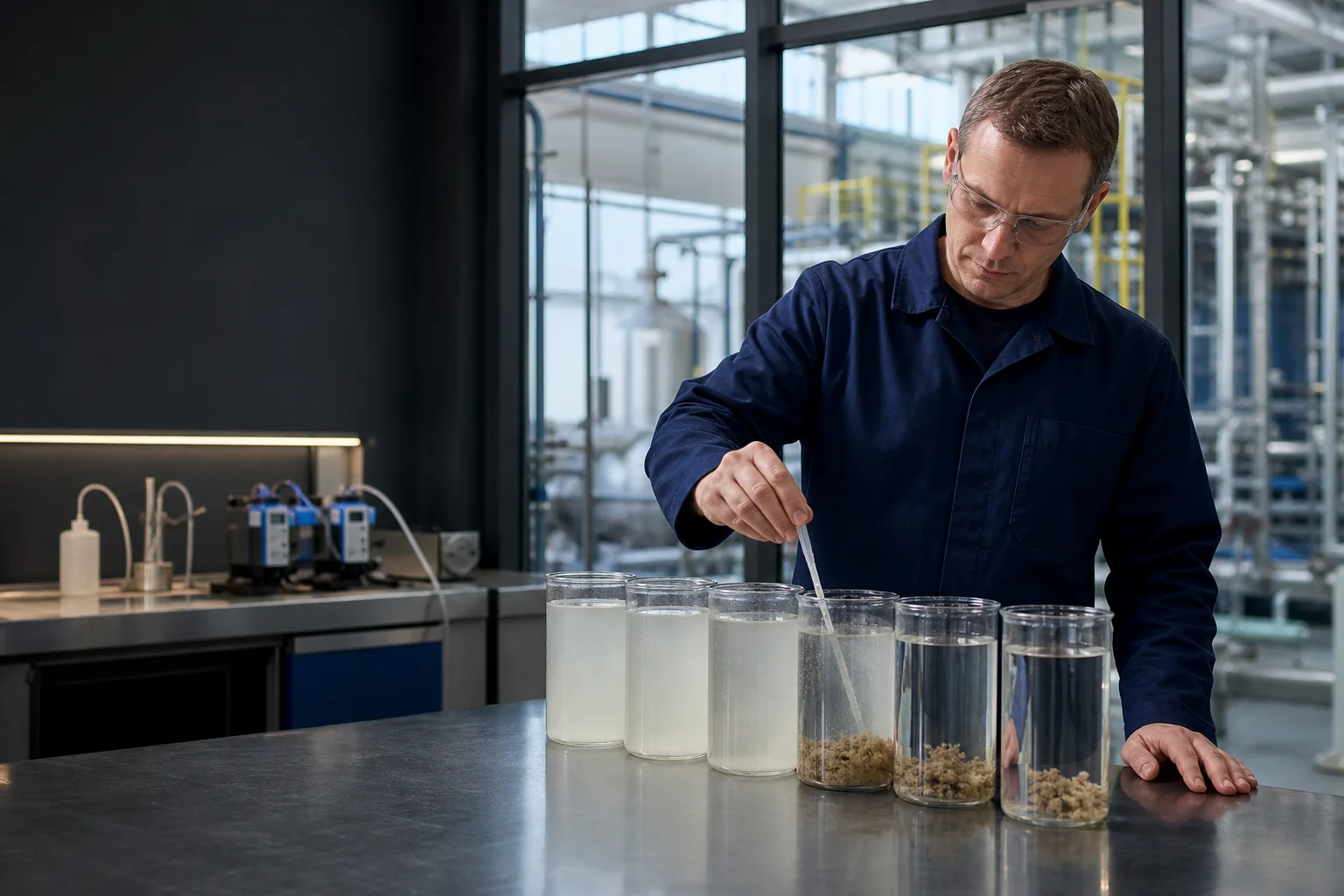
Industrial solids separation
PAM Flocculant
Select anionic, cationic or nonionic polyacrylamide from the solids, water chemistry, equipment and measurable plant target—not from a generic grade name.
PAM product families
Start with charge.
Finish with process proof.
PAM is polyacrylamide used as a high-molecular-weight flocculant. Its ionic family narrows the search, while charge density, molecular range, preparation and water chemistry determine the final grade. Compare the full selection logic.
Anionic PAM
Mineral slurry, washing water, tailings and clarification starting ranges.
Open selection path →Positive chargeCationic PAM
Organic sludge and wastewater conditioning matched to dewatering equipment.
Open selection path →Low chargeNonionic PAM
Selected acidic, low-charge and mixed-mineral systems proved by comparison.
Open selection path →Equipment fit
The separator defines what “good floc” means.
A large laboratory floc is not the final objective. Clear overflow, dense underflow, stable float, permeable cake or high capture must be confirmed under representative hydraulic and mechanical conditions.
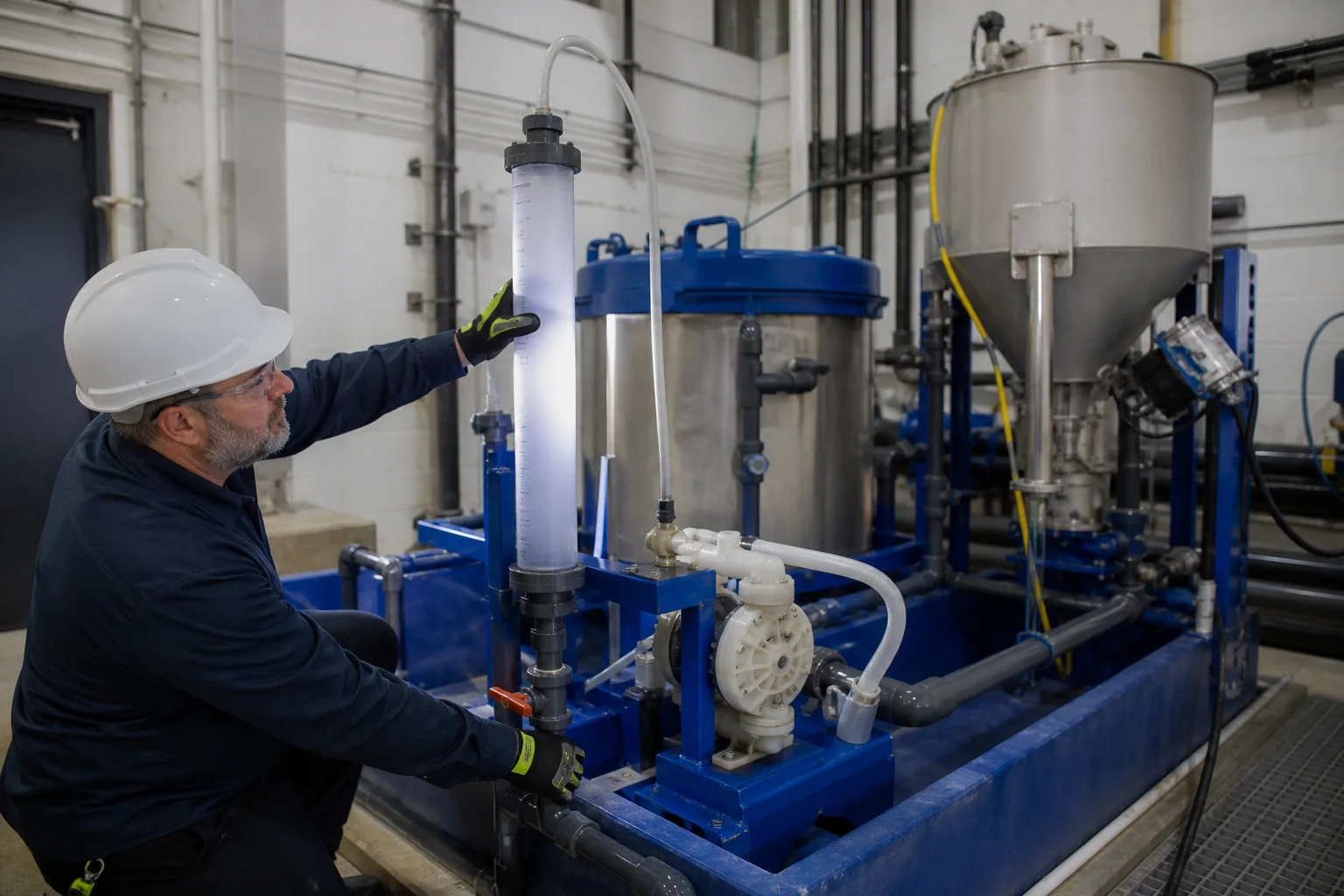
Field evidence
A pump setting is not a polymer dose.
Stock concentration, actual pump delivery, process flow and dry-solids loading convert equipment settings into active dose. Without that conversion, price and performance comparisons are unreliable.
The dosing calibration field note provides formulas and checks. The trial planner organizes feed, chemistry, equipment and acceptance data before samples are requested.
Product recommendations and export supply are provided by Gongyi Xinqi Polymer Co., Ltd.
PAM flocculant articles
Eight decisions before a stable plant result.
Each technical article addresses a distinct search and operating intent: choosing a grade, interpreting specifications, calculating total cost, diagnosing failure, calibrating dose, matching equipment, testing samples and protecting dry product.
Latest buyer and operator guides
View all articles →How to Choose a PAM Flocculant by Charge, Solids and Equipment
Choose a PAM flocculant by screening ionic charge, characterizing solids, matching separation equipment and proving a stable dose window.
PAM Flocculant Specifications Explained for Buyers
Interpret PAM flocculant molecular weight, charge density, viscosity, moisture, particle size and residual monomer without relying on misleading single values.
PAM Flocculant Price per kg vs Total Treatment Cost
Compare PAM flocculant quotations using active dose, delivered cost, solids capture, throughput, cake solids and total cost per treated unit.
Why PAM Flocculant Fails: Pin Floc, Overdose and Shear
Troubleshoot PAM flocculant failure by separating underdose, overdose, poor preparation, wrong charge, excess shear and changing feed conditions.
PAM Flocculant Dosing Pump Calibration and Dose Calculation
Calibrate a PAM flocculant dosing pump and convert stock-solution flow into active mg/L or kg/t dry solids before optimizing the grade.
PAM Flocculant for Clarifiers, DAF and Thickeners
Compare PAM flocculant requirements for clarifiers, DAF units and thickeners using equipment-specific floc, separation and control criteria.
PAM Flocculant Sample Testing Checklist
Use a repeatable PAM flocculant sample test to compare preparation, active dose, floc response, separation endpoints and scale-up risks.
Dry PAM Flocculant Storage Life and Packaging Guide
Protect dry PAM flocculant from moisture, damaged packaging, heat and contamination while managing lots, dissolved solution and warehouse handling.
Quality and supply
Approve a performing grade—and control what arrives.
Use COA, TDS and SDS for their correct purposes, specify packaging and delivered terms, and retain application evidence for incoming comparison. Review PAM quality, storage and export supply.
PAM trial request
Send the process condition, not only the product name.
Feed composition, pH or conductivity, solids, existing chemicals, equipment, current dose, target result and quantity allow the product team to select a focused sample range.
- Grade shortlist from process data
- Bench and plant-trial discussion
- COA, TDS and SDS availability
- Packaging and export quotation
Direct contact: WhatsApp +86 199 3767 3999