
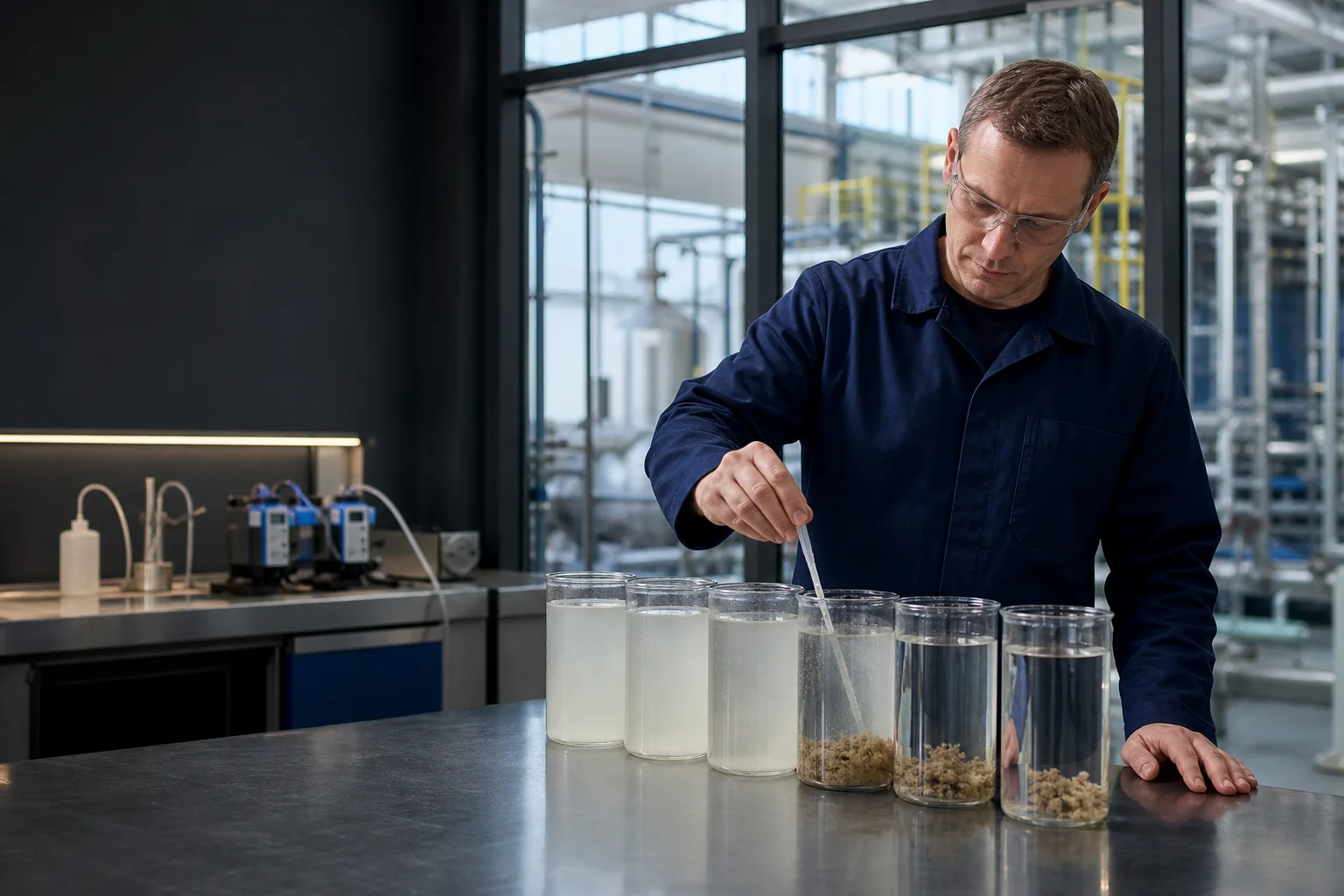
PAM flocculant sample testing should produce a traceable dose-response record, not a photograph of one clear jar. The checklist below keeps product, preparation and process variables separate so the strongest candidate can be confirmed at plant scale.
Before the samples arrive
- Define the target and acceptance measurements.
- Collect representative feed and actual make-down water.
- Record pH, conductivity, temperature and solids.
- List coagulants, pH chemicals and their addition sequence.
- Confirm the equipment and expected mixing or shear.
Prepare the polymer consistently
Label every solution with grade, batch, concentration, water, preparation time and operator. Add dry product gradually into moving water and use the same wetting and aging procedure for each grade. Do not use a visibly lumpy or incompletely hydrated solution. Protect aged solution from high shear.
Build a logical sample matrix
Start with ionic-family screening if the family is unknown. Once a family performs, compare adjacent charge or molecular ranges. Use a blank and at least four doses that bracket the expected range, including an overdose point. If a coagulant is used, stabilize its dose before varying PAM.
Keep additions comparable
Use identical sample volume, polymer-solution concentration, addition point, mixing sequence and observation time. Calculate active dose for each vessel. Avoid comparing unequal solution volumes without accounting for dilution.
Measure the separation duty
Clarification: time to floc, settling curve, supernatant turbidity and sludge volume. Thickening: settling, bed compression and overflow. DAF screen: destabilization and floc strength, followed by flotation confirmation. Dewatering: filtrate, drainage, floc strength, cake or machine endpoints.
Apply a shear check
After floc forms, apply a repeatable mixing or transfer step that represents the plant. Observe breakage and reflocculation. A fragile product can rank highly in a gentle jar but fail after a pump, feedwell or centrifuge inlet.
Record underdose and overdose signatures
Underdose may leave pin floc and haze. Overdose may create sticky solids, slow compaction or renewed turbidity. Record these signatures so operators can identify the direction of correction during the plant trial.
Shortlist on several criteria
Score target quality, active dose, operating window, floc strength, sludge or cake behavior and preparation. Do not select only the clearest jar if another candidate gives acceptable clarity with much better compaction or stability.
Plan the plant confirmation
Confirm pump calibration and stock concentration. Establish a baseline and change one product or setting at a time. Run long enough for the separator to reach representative conditions. Record feed variation, throughput and total chemical use.
Send the evidence back
Provide the dose table, photos at fixed times, feed description, solution method and equipment result. Explain why candidates were rejected. This evidence allows Xinqi Polymer to adjust the next grade range efficiently.
Protect sample representativeness
Use clean, compatible containers and record sampling point, date, time and process condition. Fill and store samples according to the site’s safety and laboratory procedure. Sludge can settle, biologically change or release gas during storage; industrial wastewater can change pH or emulsion state. Test promptly and remix only in a controlled way that does not destroy the original particle condition.
Create a test sheet before starting
| Record | Why it matters |
|---|---|
| Feed ID, pH, conductivity, temperature, solids | Confirms samples are comparable |
| Polymer grade, lot and solution batch | Maintains traceability |
| Solution concentration and aging | Converts volume to active dose |
| Addition sequence, mixing speed and time | Reproduces chemical contact |
| Measurements at fixed elapsed times | Prevents selective observation |
| Photos with jar and dose labels | Connects visual evidence to data |
Randomize when visual bias is likely
Use coded sample labels when practical so the observer does not know price or supplier during scoring. Randomize jar position if the mixer has known positional differences. Repeat the leading condition to estimate test variability before treating a small difference as real.
Score with weighted criteria
Assign weights based on the plant constraint. A thickener may weight overflow and bed density more than initial floc size. A dewatering trial may weight capture, cake and throughput. Write weights before viewing results. This prevents the team from changing the definition of success to favor the most visually dramatic sample.
Include a reference product
Test the current approved grade at its verified dose in every session. If the reference does not reproduce normal performance, investigate feed sample and method before ranking new products. A blank shows the untreated baseline; the reference shows whether the test itself is credible.
Use enough replication for the decision risk
A low-risk preliminary screen may use single jars followed by confirmation. A plant-wide replacement requires repeated bench results and a controlled production trial. Increase replication when feed is variable or the performance difference is small.
Define rejection and retest rules
State what constitutes preparation failure, contaminated feed, equipment error or an outlier. Do not quietly discard an inconvenient result. If a solution contains fisheyes or a mixer stops, document and repeat the affected condition.
Archive the decision package
Keep raw sheets, calculation workbook, photos, product documents and final approval together. Record who approved the grade and the operating limits. This package supports later lot checks, troubleshooting and supplier comparison without repeating the entire selection process.