
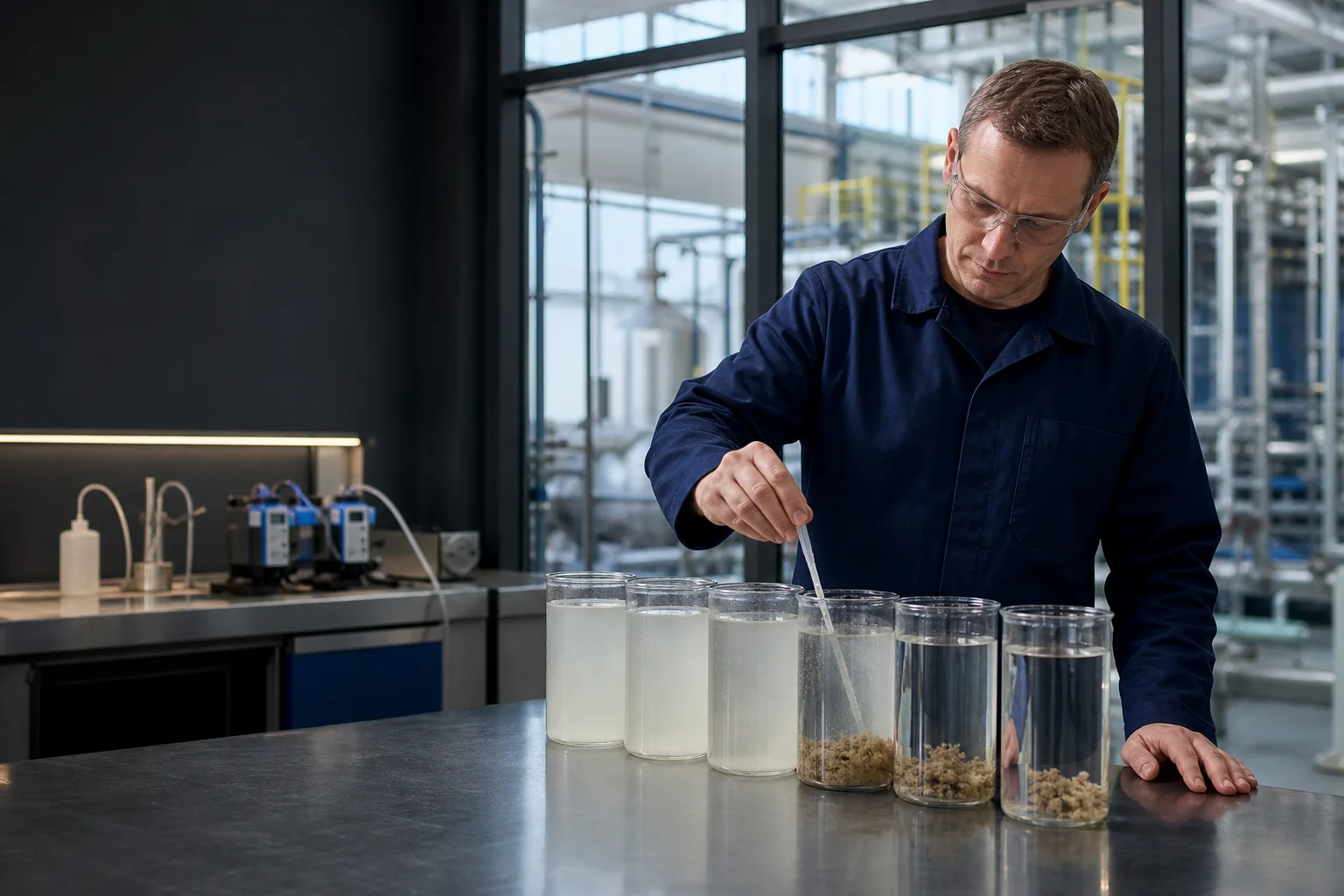
Choosing a PAM flocculant is not a matter of matching an industry name to one universal grade. The particle surface, dissolved chemistry, solids concentration, upstream chemicals and separation equipment determine which ionic family and molecular range deserves testing.
Begin with the treatment objective
Write one sentence that defines the result: “reduce clarifier overflow TSS without increasing sludge volume,” “raise belt-press cake solids while maintaining capture,” or “increase thickener throughput without unstable rake torque.” A clear objective prevents the trial from selecting a product solely because it makes large floc in a beaker.
List the current constraint and the result used to judge it. For clarification that may be turbidity, TSS, settling curve and bed volume. For flotation it may be effluent oil, float drainage and skimmer loading. For dewatering it may be capture, cake solids, filtrate, throughput and active dose.
Characterize solids and water chemistry
Identify whether the solids are biological, fibrous, clay-rich, metal hydroxide, coal, mineral, oily or mixed. Measure pH, conductivity, temperature and solids concentration. Note surfactants, dispersants, lime, PAC, alum, ferric salts and recycled water. These factors affect charge demand, polymer conformation and the apparent performance of each grade.
Collect representative samples during normal operation. A settled, aged or unusually clean grab sample can rank products differently from the real plant feed. If the process varies by shift or campaign, retain samples from the expected limits and confirm finalists against both.
Choose an ionic starting family
Cationic PAM is frequently screened for negatively charged organic sludge. Anionic PAM is a common starting point for mineral suspensions and as a coagulant aid after destabilization. Nonionic PAM can enter selected low-charge or acidic screens. These are screening conventions, not substitutes for testing.
Bracket charge and molecular range
Once a family shows promise, compare adjacent charge densities or molecular-weight ranges. Charge affects adsorption and neutralization. Molecular weight contributes bridging and solution viscosity. An extreme value is not automatically better: excessive charge can reverse particle charge, and very viscous polymer can be difficult to wet and distribute.
Match the equipment
A clarifier rewards rapid formation, robust settling and clear overflow. A thickener adds compaction and rheology. A DAF unit requires bubble attachment and a stable, drainable float. A centrifuge subjects floc to high shear; a belt or screw press depends strongly on drainage behavior. Include representative shear and contact time in the bench method, then verify on the machine.
Prove the operating window
Run a blank and several active doses. Record underdose and overdose behavior. A product that meets the target across a broad range is easier to control than one with a single sharp optimum. Repeat finalists with the actual make-down water and confirm the stock solution is fully hydrated.
Make the commercial decision
Compare active dose, delivered price, solids capture, water recovery, throughput, energy and disposal. The best purchasing decision is the lowest reliable total treatment cost at the required result. Use the trial planner to send Xinqi Polymer the process details needed for a focused sample set.
Use a starting matrix without turning it into a rule
| Feed and duty | Reasonable first screen | Evidence that decides |
|---|---|---|
| Biological sludge dewatering | Several cationic charge ranges | Capture, filtrate, cake solids, throughput and kg/t DS |
| Mineral slurry clarification | Anionic molecular and charge ranges | Settling curve, overflow, bed volume and shear resistance |
| DAF after metal-salt coagulation | Anionic and cationic candidates based on residual charge | Effluent, float stability, skimming and total chemical dose |
| Acidic or low-charge suspension | Nonionic and low-charge anionic comparison | Adsorption response, clarity, filtration and operating window |
The matrix helps organize samples; it does not select the winner. Process additives can move a feed from one apparent category to another. For example, PAC or ferric salt may leave a positively charged microfloc that responds to anionic PAM even when the original wastewater contains organic solids.
Separate screening from optimization
During screening, keep the method simple enough to compare ionic family and broad molecular range. During optimization, tighten the dose interval, test the actual chemical sequence and reproduce the hydraulic path. Trying to optimize ten grades, five doses and several coagulant levels in one uncontrolled matrix creates attractive photographs but weak evidence.
Check compatibility with the existing chemical programme
Document which chemical is added first, the delay between additions and the mixing energy at each point. A PAM that performs after correct coagulation can fail if it contacts concentrated PAC in the same pipe. Lime, oxidants, surfactants and high salt can also alter response. Do not assume the polymer must solve a coagulation or pH-control problem.
Recognize when the grade is not the main constraint
If every candidate produces incomplete wetting, repair the make-down system. If every jar remains stable, revisit pH, coagulant and particle concentration. If floc forms and then disappears after a pump, investigate shear. If performance changes by shift, examine feed variation. Product selection should follow these checks rather than conceal them with a larger sample list.
Create an approval record
Record approved product, lot, preparation, active dose range, feed limits and equipment settings. Include the underdose and overdose signatures operators observed. This record becomes the baseline for incoming checks and future quotations, and it prevents a purchasing decision from being reduced to a product code with no process context.