
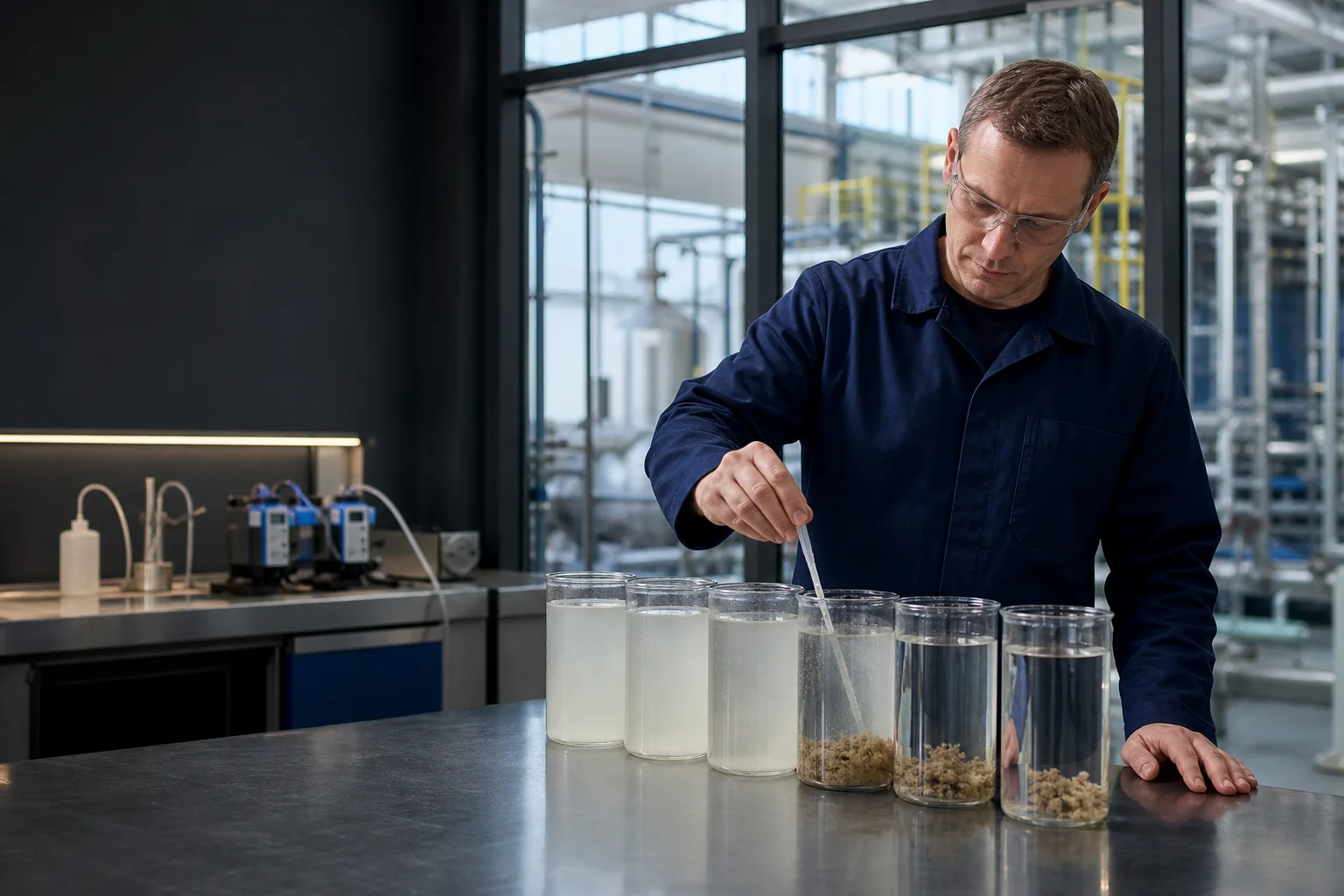
PAM flocculant failure is often blamed on the product before dose, stock concentration, mixing, feed chemistry and equipment are checked. Several different faults create similar symptoms, so troubleshooting should isolate one variable at a time.
Pin floc and persistent haze
Very small floc can indicate underdose, insufficient particle destabilization, poor polymer distribution or the wrong ionic family. Confirm the active dose and pump output. If a coagulant is used, verify its pH and dose first. Then increase PAM through a controlled curve rather than making repeated unrecorded pump changes.
Large floc that will not separate
Large, open floc may trap water, float with gas or break during transfer. In a thickener it may give poor compaction; in a DAF it may form an unstable blanket; in dewatering it may compress into an impermeable layer. Compare settling, density, drainage and shear resistance, not size alone.
Overdose and restabilization
Excess polymer can coat particles, reverse charge or create sticky solids and hazy water. Test an overdose point deliberately so operators can recognize it. If reducing dose improves the result, do not compensate by adding more coagulant without a new controlled matrix.
Fisheyes and incomplete activation
Dry powder added too quickly forms gelatinous lumps with dry centres. These fisheyes reduce active solution strength and can block equipment. Inspect wetting, feeder rate, water flow and agitation. Confirm that the solution receives adequate aging before use.
Chain damage from shear
High-speed mixers, centrifugal pumps, throttled valves and turbulent injection points can damage activated polymer or formed floc. Compare a gently handled laboratory solution with plant solution. If the jar test succeeds before pumping and fails after pumping, inspect the hydraulic path.
Changing make-down water
Conductivity, hardness, iron, oxidants and temperature can alter solution behavior. If the plant switches between fresh and recycled make-down water, prepare the same grade in both and compare viscosity and performance. Protect polymer from incompatible oxidants and follow supplier instructions.
Changing feed or upstream chemistry
Storm flow, production campaigns, sludge age, pH adjustment and coagulant carryover can move the optimum. Record feed measurements with each trial. A product that appears inconsistent may be responding predictably to an unrecorded process change.
A disciplined diagnostic sequence
- Verify pump calibration and active dose.
- Inspect wetting, concentration and aging.
- Test fresh feed with a blank and dose curve.
- Compare solution before and after transfer equipment.
- Check pH, conductivity, solids and upstream chemicals.
- Only then compare adjacent PAM grades.
Document the observed failure mode and send it with the sample request. The dosing calibration guide and trial planner help separate mechanical and chemical causes.
Use the symptom as a clue, not a diagnosis
| Observed symptom | Possible causes | First controlled check |
|---|---|---|
| Persistent pin floc | Underdose, wrong charge, poor coagulation, weak distribution | Blank and dose curve after verified coagulation |
| Sticky floc or slimy solids | Overdose, concentrated contact, poor dilution | Reduce active dose and inspect dilution point |
| Good jar, poor plant | Shear, wrong injection point, pump error, hydraulic short circuit | Sample before and after transfer; calibrate feed |
| Clear water, weak compaction | Open floc structure, excessive dose, unsuitable molecular range | Measure bed volume or drainage, not clarity alone |
| Intermittent performance | Feed variation, pulsating pump, aging inconsistency | Time-align feed, dose and quality records |
Confirm the mass balance
Compare bag consumption or solution depletion with calculated active feed. A large difference can reveal feeder bridging, water-flow error, pump slippage or an incorrect stock concentration. Inventory does not replace calibration, but the two should agree over a suitable period.
Test the solution itself
Collect freshly prepared solution and inspect for lumps, undissolved particles or unusual viscosity. Compare solution from the aging tank with solution at the injection point. A large change after transfer suggests mechanical damage, contamination or excessive residence time. Use safe sampling procedures and never judge by touching polymer solution.
Trace the timeline
Align changes in raw feed, pH, conductivity, coagulant, polymer batch, solution preparation, flow and separator performance. A trend chart often exposes a delayed relationship that a single jar test misses. For example, a new batch may be blamed when storm flow or sludge blend changed several hours earlier.
Set escalation criteria
Operators should know when to adjust dose, when to repeat a jar test and when to stop and inspect equipment. Define maximum acceptable turbidity, torque, blanket level or filtrate solids. Repeatedly increasing polymer without a boundary can worsen overdose and delay correction of a mechanical fault.
Preserve a reference sample and result
Where storage and site procedures permit, retain approved product and its reference test. Compare suspected material with the retained grade using the same fresh feed. If both fail, the process has likely changed. If only the new material fails under a controlled test, provide the lot, COA and test record to the supplier.
Return the process to a stable baseline
After identifying the fault, return concentration, dose, mixing and separator settings to documented values. Confirm performance over more than one sample interval. Record the root cause and corrective action so the same symptom does not trigger another uncontrolled product change.