
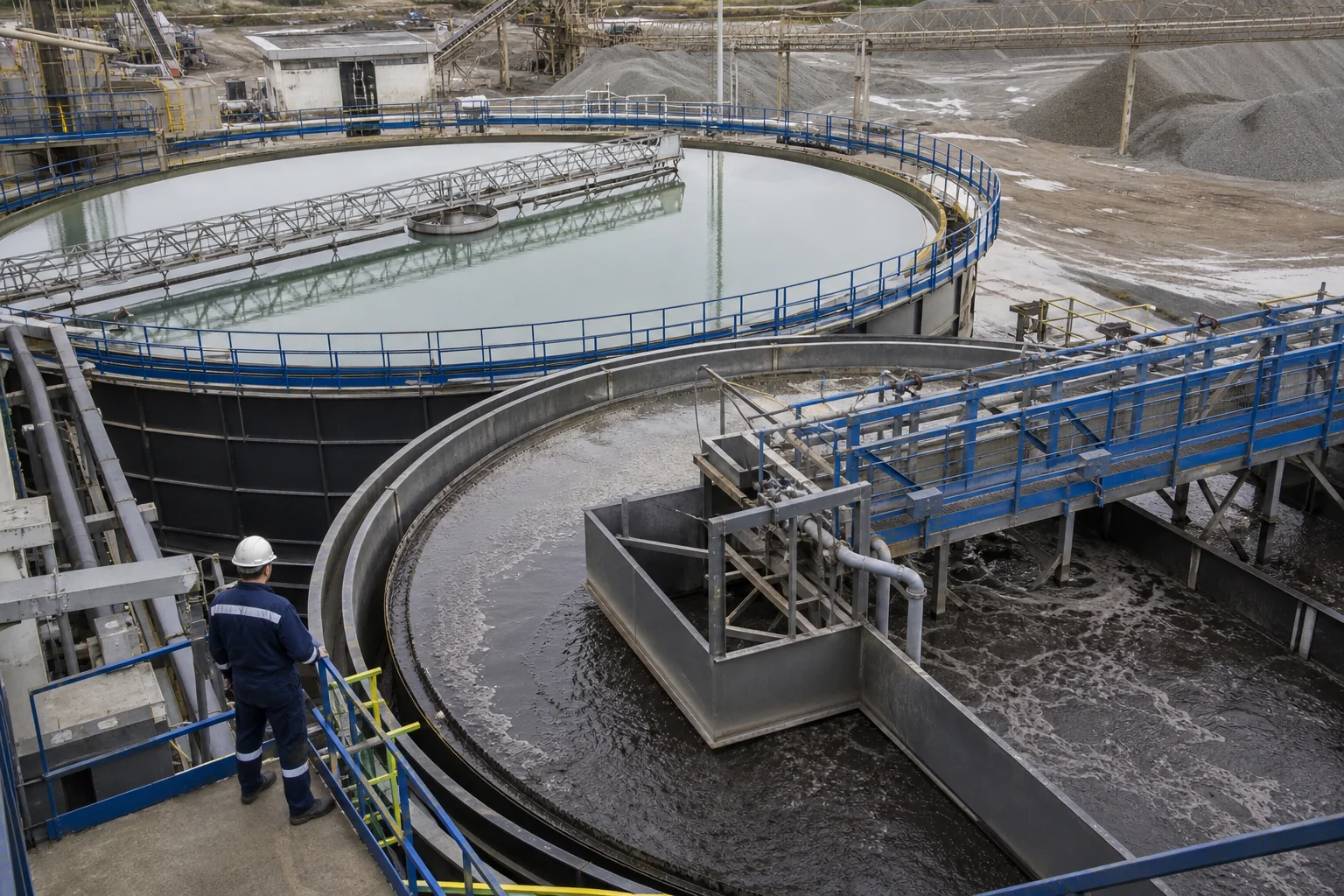
Anionic PAM flocculant is widely screened where long polymer chains can adsorb onto suspended mineral or inorganic particles and bridge them into larger, separable flocs. The useful charge and molecular-weight range must be verified with the actual slurry and process water.
Typical starting applications
- Sand and aggregate washing water containing clay and silt
- Mine tailings thickening and process-water recovery
- Coal washing and fine-particle clarification
- Metal-hydroxide or inorganic precipitate settling after pH adjustment
- Clarifier or lamella duties after PAC, alum or ferric coagulation
These are starting points, not guarantees. Residual coagulant can change surface charge. High conductivity can contract the polymer chain. Clay type can dominate demand even when the bulk solids are similar. A sample recommendation should therefore include pH, conductivity, suspended solids, current chemicals and the separation equipment.
Variables that change the grade ranking
Charge content influences adsorption and compatibility with the particle surface. Molecular weight contributes chain length and bridging, but extremely viscous solutions can be difficult to distribute. Hydrolysis distribution and molecular architecture influence performance in saline or variable water. The best grade is the one that maintains clarity, settling and compaction across a usable dose window.
Bench-test endpoints
For a clarifier, record time to visible floc, initial and zone settling velocity, supernatant turbidity, interface definition and final sludge volume. For a thickener, add underflow density, rake response and overflow quality during a continuous trial. For filtration, compare filtrate clarity, cycle time, cake release and moisture. The clarifier and thickener guide connects these endpoints to equipment behavior.
Information for a sample request
Send the mineral or precipitate type, slurry solids, pH, conductivity, temperature, existing coagulant, flow, equipment, present active dose and target. If a current product works but is expensive or unstable, include its ionic type and observed failure mode. Xinqi Polymer can then select a narrow sample set rather than supplying unrelated grades.