
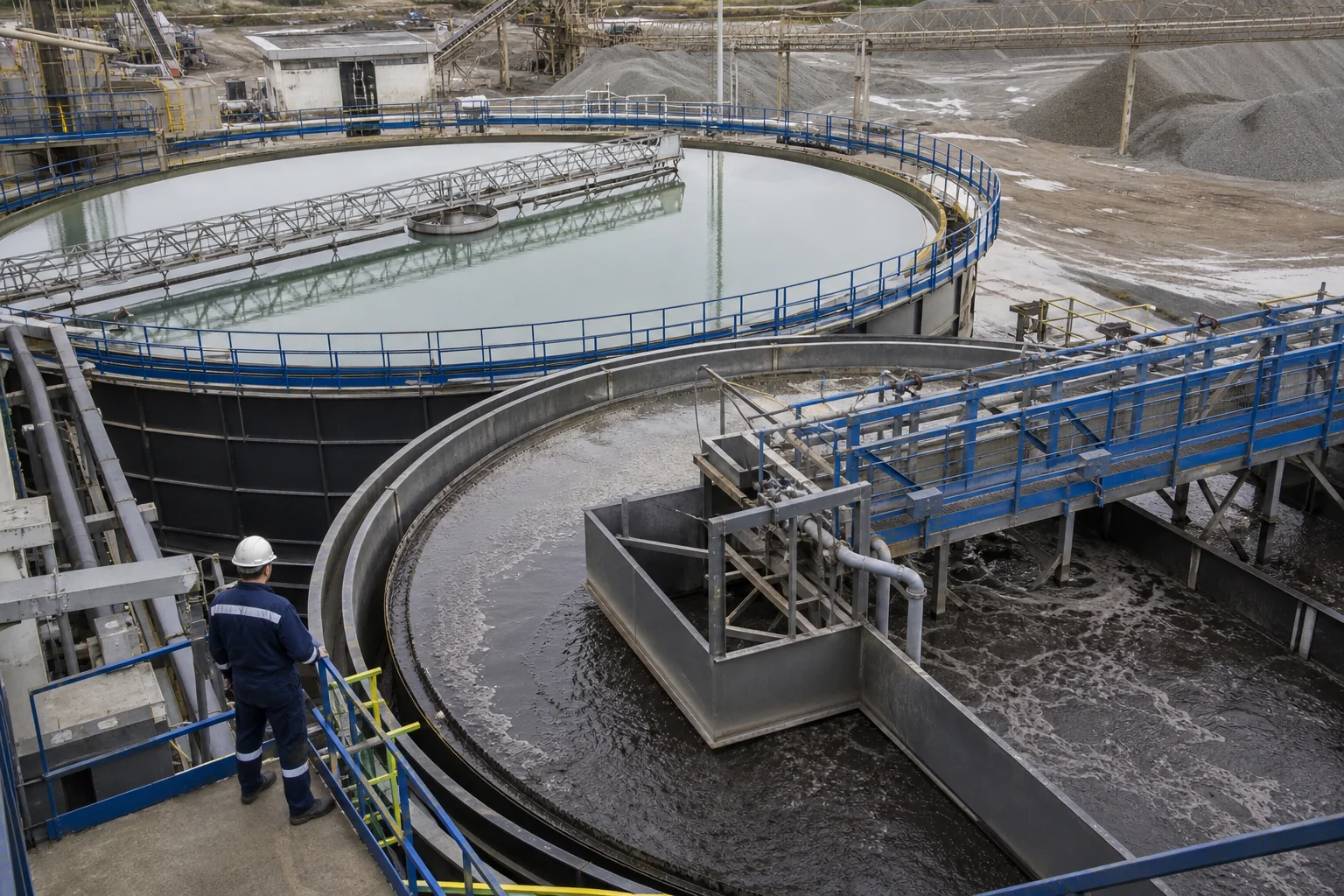
PAM flocculant for a clarifier or thickener must create floc quickly enough for the available residence time while preserving overflow clarity and manageable underflow. The fastest-settling beaker is not always the best plant choice.
Clarifier and thickener objectives differ
A clarifier commonly prioritizes clear overflow and hydraulic capacity. A thickener must also compact solids without excessive yield stress or rake load. Very large, open flocs may settle rapidly yet trap water. Dense floc may compact well but form slowly. State the priority before comparing products.
Run a controlled settling test
Use representative feed and actual make-down water. Screen ionic family first, then bracket charge or molecular weight within the strongest family. Record time to floc, settling curve, interface definition, supernatant turbidity and final bed volume at a fixed time. Repeat the best candidates after applying representative shear.
Check the injection point
The polymer should disperse before solids enter the separation zone, but formed floc should not pass through a high-shear centrifugal pump. Inspect inline mixers, pipe velocity, valves and feedwell energy. Split dosing may help some variable feeds, but it should be demonstrated rather than assumed.
Move to a plant trial
Compare active dose, overflow suspended solids, underflow density, throughput, rake torque and operator interventions over several feed cycles. A broad operating window often has more value than a narrow optimum. Send this data with the trial record when asking for the next sample adjustment.