
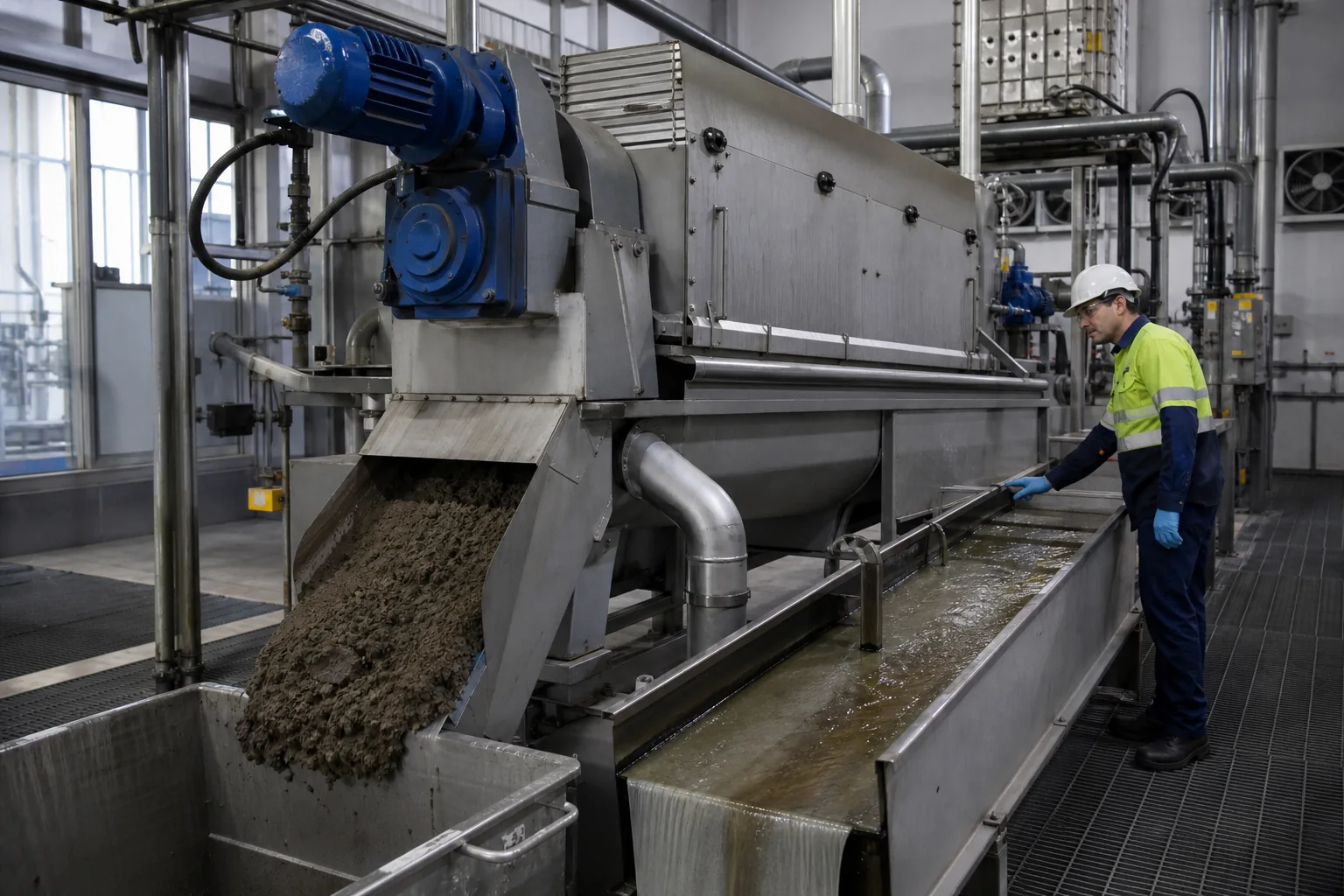
Cationic PAM flocculant is a common starting family for biological and other organic sludges. Its positive charge can reduce repulsion between negatively charged particles while the polymer chain bridges solids into flocs that can drain, compress or centrifuge.
Match charge demand to the sludge
Waste activated sludge, digested sludge, primary sludge, paper sludge, food-processing residues and oily industrial sludge do not have the same charge demand. Residual ferric or aluminium coagulants, lime, pH, volatile solids and storage time can change the response. The highest cationic charge is not automatically the most effective or economical choice.
Match floc structure to the machine
A centrifuge needs rapid conditioning and floc that resists high shear. A belt press needs free drainage in the gravity zone and enough strength for compression. A screw press exposes conditioned sludge to a longer mechanical path. A plate-and-frame press may prioritize permeability and cake release. The sludge-dewatering equipment guide explains the trial endpoints for each duty.
Compare active dose and total result
Express dose as kilograms of active polymer per tonne of dry solids whenever possible. Record solids capture, filtrate or centrate quality, cake solids, throughput, torque or pressure, wash-water demand and polymer consumption. A visually impressive floc can still produce a poor cake, while a higher unit-price grade may reduce total cost if it improves capture or lowers hauling.
Preparation affects cationic PAM performance
Dry polymer must be wetted evenly, hydrated fully and protected from high shear after activation. Poor make-down creates fisheyes and an unstable feed concentration. Salty or hard dilution water may reduce chain extension. Before rejecting a grade, confirm the feeder, water flow, aging time, transfer pump and calibration column.
Data for grade recommendation
Provide sludge source, dry-solids percentage, pH, temperature, volatile-solids level if available, current chemicals, dewatering machine, current product and dose, cake solids, capture and monthly demand. Fresh sludge or a representative sample is more useful than a generic industry description.