
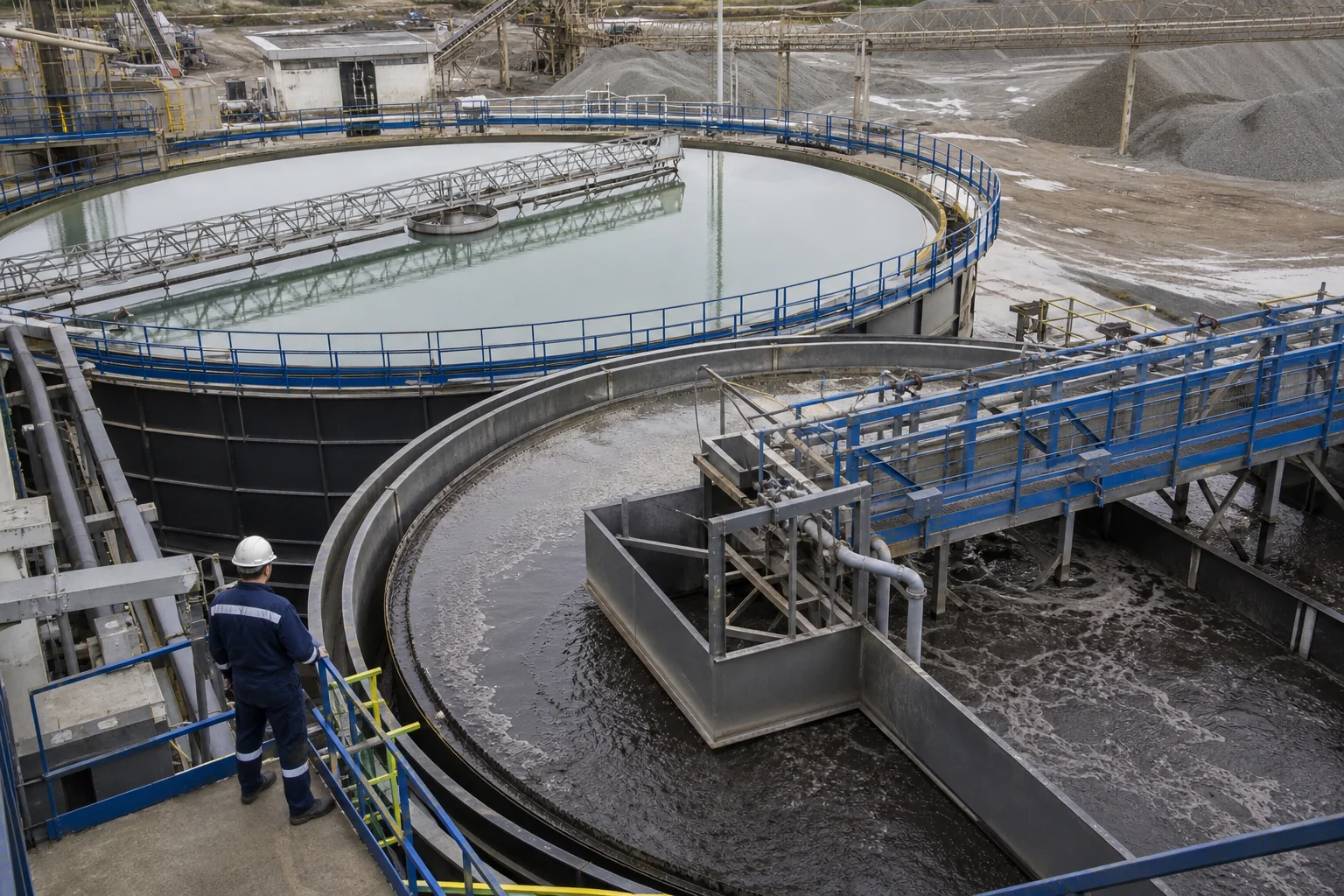
Clarifiers, DAF units and thickeners all use flocculation, but they reward different floc properties. A PAM grade that settles well can perform poorly in flotation, and a product that gives clear overflow may not create dense thickener underflow.
Clarifier: clarity and hydraulic stability
The clarifier needs floc that forms within the available contact time, settles faster than the upward water velocity and resists inlet-zone shear. Measure overflow turbidity or TSS, settling curve, sludge blanket, hydraulic loading and dose. Watch for pin floc during high flow and rising sludge caused by gas.
DAF: bubble attachment and float handling
The DAF requires destabilized particles that attach to microbubbles and rise into a coherent float. Floc cannot be so dense that it settles or so fragile that recycle-water turbulence breaks it. Evaluate effluent, float thickness, skimmability, oil capture, recycle pressure and air release. Coagulant sequence is often as important as PAM grade.
Thickener: settling plus compaction
A thickener must produce clear overflow and dense, pumpable underflow. Large open flocs may settle quickly but trap water. Test final bed volume and compression, not only initial velocity. At plant scale track rake torque, bed level, underflow density and recovery.
How product choice can differ
Anionic PAM is frequently screened for mineral clarification and thickening. Cationic or anionic products may be evaluated in industrial DAF depending on feed and coagulant. Molecular weight, charge and structure then tune floc size and strength. The PAM type guide explains the families without assigning a universal grade.
Design an equipment-specific jar test
Use mixing and observation stages that represent the unit. For gravity separation, record a settling curve and apply representative transfer shear. For DAF, conventional settling jars cannot reproduce microbubble attachment; use bench flotation where available and treat the jar test as a chemical screen only.
When a successful bench result fails in the plant
Inspect dilution, injection point, mixing, hydraulic short circuiting, recycle conditions and feed variability. Confirm active dose by calibration. A laboratory product ranking is only valid if plant preparation and contact conditions are comparable.
Prepare a useful sample request
Send equipment type and dimensions where relevant, flow, feed solids, pH, conductivity, current coagulant, injection sequence, current dose and the limiting endpoint. For DAF include recycle pressure and the material to be removed. For a thickener include feed and target underflow solids.
Compare the units side by side
| Unit | Dominant separation force | Critical floc property | Plant endpoints |
|---|---|---|---|
| Clarifier | Gravity settling | Fast formation and shear-resistant settling | Overflow TSS, blanket, hydraulic rate, dose |
| DAF | Microbubble flotation | Bubble attachment and drainable float | Effluent, float, skimmer, recycle, dose |
| Thickener | Gravity settling and compression | Settling plus dense, pumpable bed | Overflow, underflow solids, torque, bed level |
Adjust the chemical sequence
A clarifier treating mineral solids may use direct anionic PAM. A DAF treating emulsified food wastewater may need pH adjustment, coagulant and then PAM. A thickener may receive slurry already influenced by grinding reagents or dispersants. Draw the actual sequence with addition points and delays before transferring a product between units.
Respect different residence times
A compact DAF contact zone and a large gravity thickener do not provide the same time for floc development. Rapid adsorption may matter in a short contact path, while slow compaction can control thickener performance. Reproduce the relevant time scale during screening and do not prolong every jar test until all products appear successful.
Consider recycle streams
DAF recycle water changes air release and dilution. Clarifier sludge recycle can increase solids inventory. Thickener overflow may return dissolved salts or residual polymer upstream. Include recycle conditions in the trial record because a product change can alter more than one unit.
Protect downstream operations
Clarifier overflow may feed filters or membranes. DAF effluent may enter biological treatment. Thickener underflow may be pumped or filtered. Evaluate residual solids, carryover and rheology against the next unit. The best local result should not create filter fouling, unstable biology or unpumpable underflow.
Interpret carryover correctly
Solids in a clarifier overflow can come from insufficient flocculation, hydraulic overload, density currents or rising sludge. DAF carryover can reflect poor air release, short circuiting or a float blanket that is not removed at the correct rate. Thickener overflow can deteriorate when bed level or rake condition changes. Confirm the separator condition before treating every carryover event as a request for more polymer.
Collect feed and effluent samples at coordinated times that reflect the unit residence period. A grab sample taken immediately after a dose change may still represent the previous operating condition.
Plan a product transfer between units
If one site wants a single PAM for several duties, test each duty separately and calculate the operational compromise. Inventory simplification has value, but forcing one grade across incompatible feeds can raise total dose and upset risk. Approve separate operating ranges even when the product code is shared.
Use a structured commissioning sequence
- Confirm mechanical condition and baseline.
- Stabilize pH and primary coagulant.
- Calibrate stock concentration and PAM feed.
- Screen grade and dose at representative flow.
- Observe downstream effects over the unit residence time.
- Record stable operating limits and alarm symptoms.