
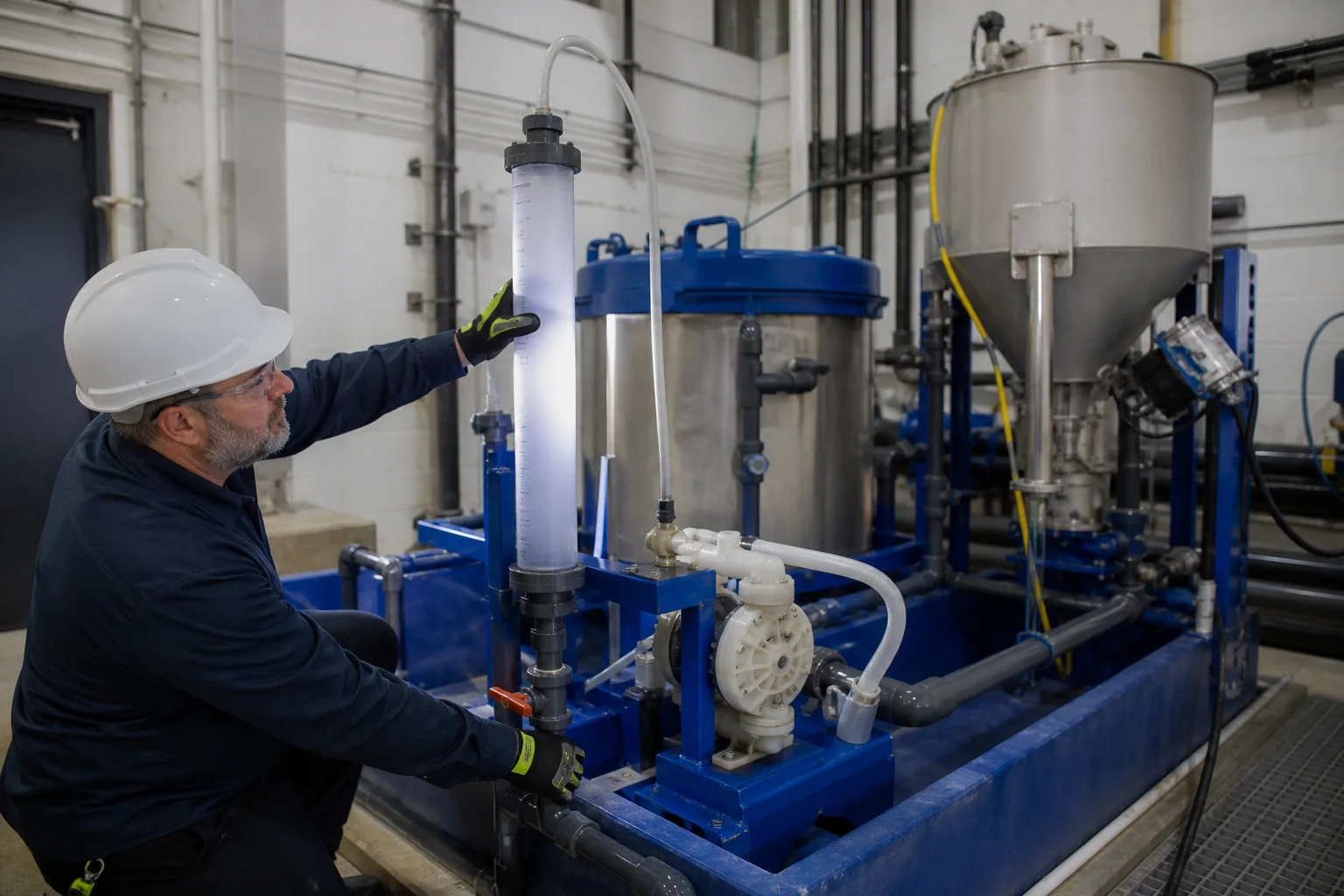
Dry PAM purchasing should include the powder feeder and wetting system. A grade that performs well after careful laboratory preparation can still be difficult to use if the delivery package, particle behaviour or addition rate does not suit the installed equipment. Review handling without mistaking free-flowing powder for proven treatment performance.
Describe the feeder and transfer route
Provide the feeder type, hopper arrangement, transfer method and package handling procedure. Identify whether the plant uses small bags or a bulk-container unloading system. Ask the equipment supplier about relevant material and particle constraints before turning them into a purchasing requirement. Do not assume that every granular PAM product feeds at the same screw setting. A change in bulk behaviour can alter the actual mass addition even when the control setting is unchanged.
Measure powder delivery and wetting
Calibrate the dry addition rate safely using a representative method and compare it with the intended solution concentration. Observe the wetting arrangement at the normal and peak feed rates. Excessive addition can cause agglomeration and apparent preparation failure. Keep water flow, temperature and aging documented. The fast-dissolving product review distinguishes a handling claim from a usable prepared solution, while dose calibration connects preparation to the actual treatment dose.
Control moisture exposure at the point of use
Review humidity, wet cleaning nearby, package opening and the residence time of powder in the hopper. Confirm cleaning and isolation procedures with the equipment team. Storage conditions and exposed feeder conditions are not identical. Caking or bridging may reflect the operating environment rather than a change in polymer chemistry. Follow the product SDS and site procedure for handling; do not create an improvised mechanical intervention around running feeder equipment to keep a trial moving.
Approve handling and application together
Record package suitability, measured feed rate, preparation result and separator performance for the candidate. If a product requires a different feeder setting or preparation cycle, document that change rather than transferring the incumbent settings by default. Request the supplier’s relevant product information and confirm whether future lots maintain the agreed identity. Powder appearance and feeder convenience do not replace treatment acceptance, so retain both operating and application evidence in the purchasing file.
Purchase review worksheet
Complete the evidence column with measured values, observations or an agreed document reference. An unanswered item is a reason to clarify the sample or quotation, not to assume that two products are equivalent. Keep the same worksheet with the trial record so the purchasing and operating teams approve the same conditions.
| Review item | Evidence to obtain | Decision before ordering |
|---|---|---|
| Equipment | Feeder, package transfer and supplier constraints | Quoted product suits the actual handling system |
| Calibration | Measured powder rate and controlled wetting | Stock concentration is established from evidence |
| Environment | Humidity, hopper exposure and safe cleaning procedure | Handling problems are distinguished from grade failure |
Request a focused PAM flocculant quotation
Send the feed source, solids concentration, pH or conductivity, operating temperature and separator type alongside the monthly quantity, package preference and destination. Include the specific observations in the worksheet above. If a current grade is being replaced, provide its available technical data and the active dose rather than only the trade name. Commercial availability, sample quantities and delivered terms should be confirmed for the selected product, not inferred from an illustrative application.
Arrange the comparison through the PAM trial planner and review quality documents and supply requirements before committing to a shipment. Gongyi Xinqi Polymer Co., Ltd. can review the application information and discuss a suitable sample range. Application suitability remains conditional on representative testing; a polymer recommendation is not a guarantee of plant performance or regulatory compliance.