
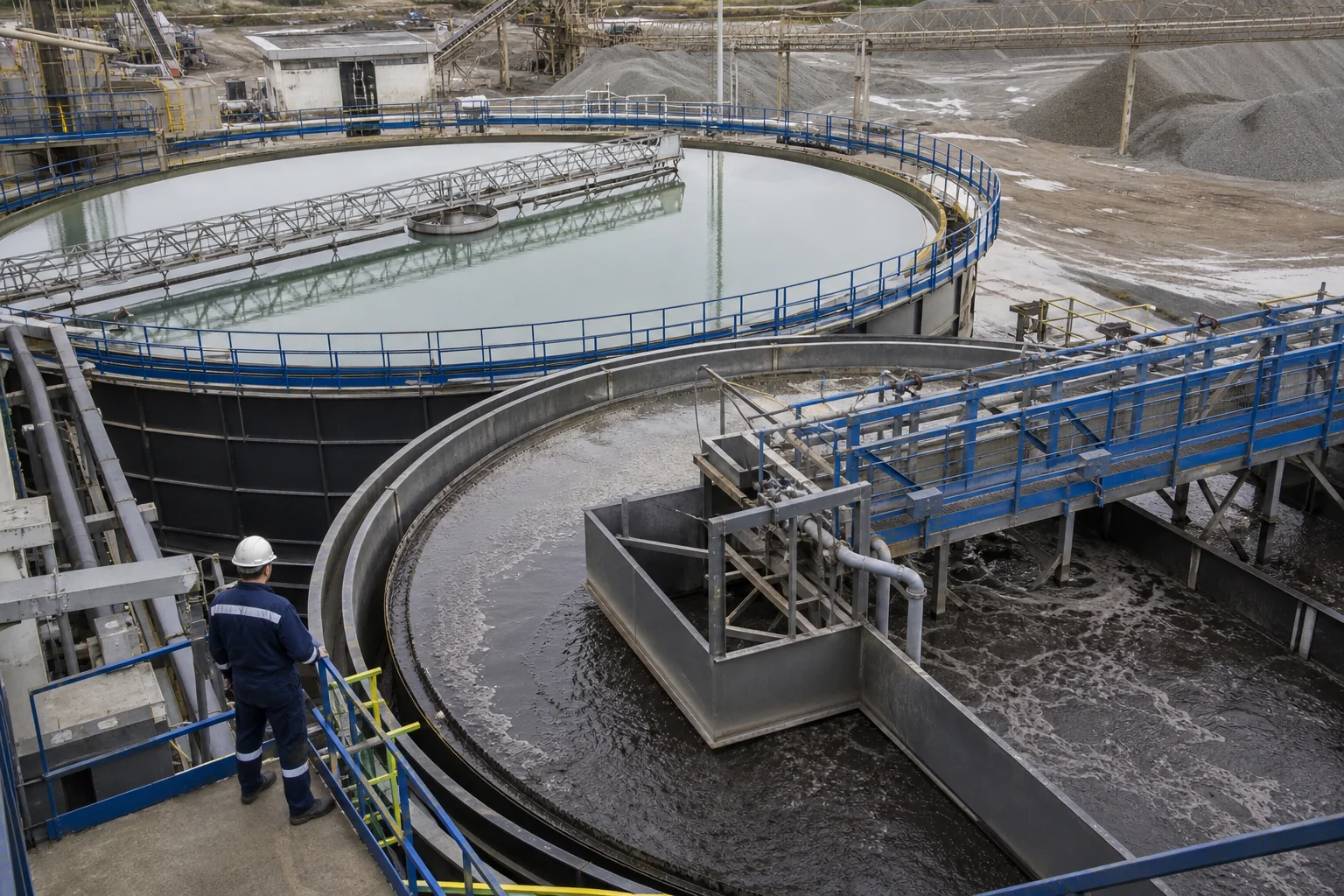
Concrete wash water is not just a suspension of harmless sand. Fine solids, alkaline chemistry and the proposed reuse or discharge route all matter. PAM selection can address a solids-separation duty, but it does not replace the broader treatment and water-quality checks required for the actual plant.
Describe collection and upstream conditioning
State whether washout, equipment cleaning and other production waters are combined. Record pH and solids concentration, including fluctuations after cleaning or high production. Identify any upstream adjustment or coagulation used before polymer addition. Compare candidates on water that has undergone the intended treatment steps. Do not present a clear supernatant as proof that pH or dissolved constituents are acceptable. Those endpoints require their own process controls and verification.
Test clarification against available residence time
Measure suspended-solids carryover and settling over the actual operating window. Record the effect of mixing and transfer where the plant exposes the floc to shear. A dose optimum in a clean jar does not prove performance in a loaded recycling tank. Use clarifier and thickener criteria to evaluate overflow and underflow together. Avoid assuming that all concrete wash-water duties need the same charge or molecular range.
Confirm the requirements of the reuse destination
Where recovered water is intended for production, agree the relevant quality limits with the responsible production team. Requirements depend on the intended use; suspended-solids reduction alone cannot establish universal reuse suitability. Include variability of recycled water in the polymer comparison. If another treatment stage follows clarification, review its compatibility and loading constraints. Qualification should clearly state what was measured and what remains outside the polymer trial.
Purchase for the full operating duty
Include sludge pumping or dewatering observations and estimate polymer use on a stated dose basis. Check make-down capacity and storage protection at the delivery site, especially where wet equipment and powder storage are close together. Provide the expected consumption and package handling method in the RFQ. The purchase specification checklist helps turn the trial into an approved product identity and receiving record rather than a generic “concrete polymer” order.
Purchase review worksheet
Complete the evidence column with measured values, observations or an agreed document reference. An unanswered item is a reason to clarify the sample or quotation, not to assume that two products are equivalent. Keep the same worksheet with the trial record so the purchasing and operating teams approve the same conditions.
| Review item | Evidence to obtain | Decision before ordering |
|---|---|---|
| Chemistry | pH range and upstream treatment | Polymer trial does not substitute for chemical control |
| Reuse | Intended destination and agreed water-quality endpoints | No unsupported universal reuse claim |
| Solids handling | Settling, transfer and residual sludge behaviour | Selected grade supports the complete duty |
Request a focused PAM flocculant quotation
Send the feed source, solids concentration, pH or conductivity, operating temperature and separator type alongside the monthly quantity, package preference and destination. Include the specific observations in the worksheet above. If a current grade is being replaced, provide its available technical data and the active dose rather than only the trade name. Commercial availability, sample quantities and delivered terms should be confirmed for the selected product, not inferred from an illustrative application.
Arrange the comparison through the PAM trial planner and review quality documents and supply requirements before committing to a shipment. Gongyi Xinqi Polymer Co., Ltd. can review the application information and discuss a suitable sample range. Application suitability remains conditional on representative testing; a polymer recommendation is not a guarantee of plant performance or regulatory compliance.